


Throughout history, money has never been defined by promises or paper claims, but by scarcity and trust.
Silver, like gold, fulfilled that role for centuries. Yet in recent decades, it has been gradually pushed aside, dismissed as secondary and buried under layers of paper contracts and financial engineering.
Today, that illusion is beginning to crack.
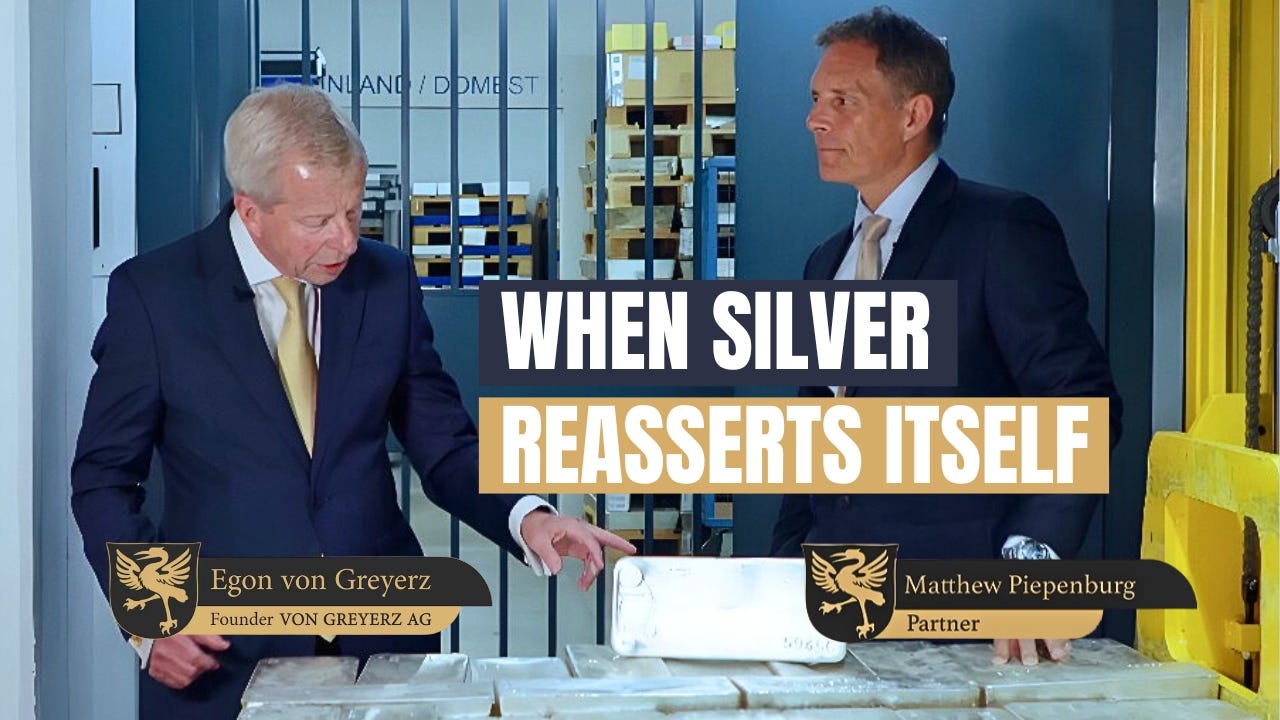
Physical shortages and rising real demand are quietly restoring silver’s relevance, not as a speculative trade, but as a tangible form of real money in a monetary system that is steadily losing credibility.
In this short discussion, Egon von Greyerz and Matthew Piepenburg of VON GREYERZ explain what 1,000-ounce silver bars represent, why they are held by central banks and large investors, and why silver continues to play a critical role in wealth preservation portfolios.
With silver once again trading above $50 per ounce — a level it has reached only three times in modern history, we examine why this moment may be fundamentally different, how persistent supply shortages and industrial demand are reshaping the market, and why physical silver stored outside the banking system remains an essential form of real, enduring wealth.
This is not about speculation. It is about understanding money, preserving purchasing power, and preparing for a world in which tangible assets reassert their role.
KEY INSIGHTS
00:00 – 00:20 | Silver Beyond the Label
Silver is often dismissed as “poor man’s gold,” yet its role today reflects intelligence, not affordability.
The discussion begins inside a secure vault, reinforcing the distinction between physical metal and paper claims.
00:20 – 01:00 | Physical Reality vs. Paper Illusion
What matters is not silver’s price, but its physical presence and scarcity.
Large silver holdings are not consumer assets; they belong to institutions, central banks, and long-term capital.
01:00 – 01:40 | Monetary Debasement in Perspective
Silver’s price history is less about volatility and more about currency erosion.
Since the end of gold backing, precious metals have reflected the steady loss of purchasing power in paper money.
01:40 – 02:20 | A Structural Supply Deficit
Silver faces a persistent imbalance: demand exceeds supply year after year.
This deficit is structural, not cyclical, and cannot be resolved through monetary policy.
02:20 – 03:00 | Why This Cycle Is Different
Previous silver spikes were driven by speculation.
Today’s demand is grounded in industrial necessity and physical scarcity, changing the nature of the market.
03:00 – 03:40 | Silver’s Role in Wealth Preservation
Gold remains the primary anchor of monetary stability.
Silver complements gold by offering exposure to scarcity with greater responsiveness.
03:40 – 04:20 | Velocity Matters
In periods of monetary transition, silver historically moves faster than gold.
This is not leverage — it is the result of a tighter physical market.
04:20 – End | Ownership Over Price
The key decision is not timing, but how and where silver is held.
Physical ownership, outside the banking system, defines true wealth preservation.


